


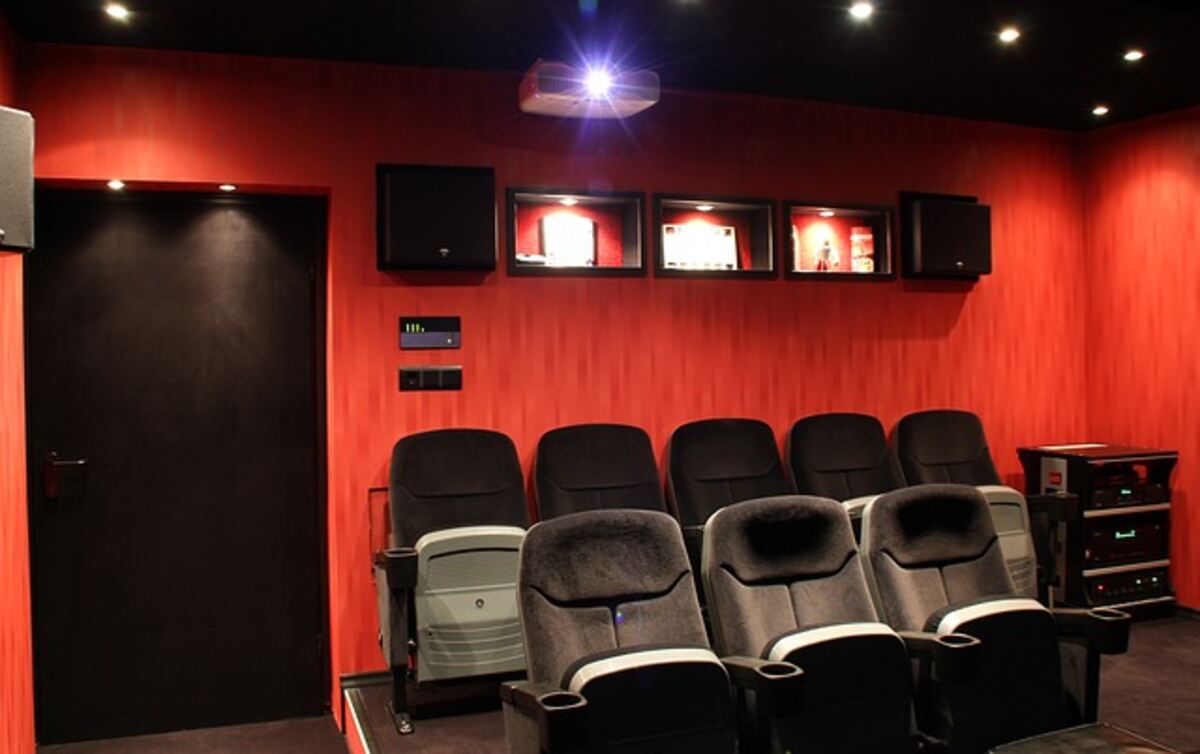
Video projectors for the home theater
Regarding home entertainment systems, projectors are among the best options since they let you make the most of the space you already have and often deliver a large screen at a lower cost than DLP, LCD, or Plasma displays. Pay close attention to the projector’s aspect ratio. 16:9 is the standard for widescreen, while 4:3 is more like the old CRT televisions.
A home theater projector obtains a video signal and then is projected onto a screen or wall. Typically, a projector is mounted on the ceiling to point directly at the screen or wall in front of the audience.
Considering the room’s dimensions and lighting conditions is crucial when purchasing a projection television. These factors will directly affect the number of lumens your projector needs to produce a clear, readable image.
Projectors for the Home Theater
Today’s market offers a wide selection of projector designs. This decision should be made considering available space, individual tastes, and financial constraints.
A Cathode Ray Tube (CRT) projector functions similarly to an older television model. The projected image comprises tubes glowing in red, blue, and green. Because of its age, this projector is the cheapest option currently on the market. CRT projectors have several benefits, including their longevity and the fact that their tubes never lose brightness. Large-scale graphics should be a standard feature of professional CRT projectors. They have deeper blacks than LCD and DLP projectors. Also, unlike with some DLP projectors, the “rainbow effect” should not appear on a CRT projector. CRTs have benefits and drawbacks that are similar to those of other projectors. CRT projectors are more significant and bulkier than LCD and DLP models, requiring more time and effort to set up correctly. They have a more substantial impact on the environment in terms of energy consumption and cost of operation.
A liquid crystal display projector (LCD) uses a prism to separate white light into its component colors (red, green, and blue) for projecting a picture. The portability and small size of LCD projectors are two significant advantages. The image can be projected onto any smooth surface. They are unaffected by glare and can keep their contrast even in bright environments. They can be placed on the wall and do not consume much power. The lack of actual black, image distortion, pixel death, and ghosting are just a few issues that can arise.
Texas Instruments owns the patent for the technology behind the DLP projector, also known as a digital light processing projector. The mirrors serve as “pixels” in the projected image, allowing the device to function. If there are more mirrors, the image will be more transparent. DLP projectors are often only used in more upscale cinemas. There’s a price increase and the possibility of a “rainbow effect” with them.
Plasma projectors have many advantages over conventional CRT projectors, including their portability, ability to be mounted on walls, lightweight, and lack of bulk, as well as their ability to display accurate colors, produce deep, rich blacks, allows for viewing from wide variety of angles, and lack of motion blur. However, there are a few drawbacks to consider, such as the possibility of screen burn-in, a gradual decrease in brightness, glare in brighter rooms, a high power requirement, and a larger footprint than LCD projectors.
Where could I find a surface to put the image on?
Home theater projector shoppers frequently ask us about screen types and colors and whether they should project onto a screen or a wall. When choosing a screen or designing a fence for your home theater, you need to think about the ambient light, the placement of the projector, and the room’s dimensions.
Walls
Related Posts
If you have a suitable wall, you can project your image onto it. The type of projector you choose will determine the wall color. Flat white is a popular choice for many homeowners. However, many would instead utilize a special paint made in home theaters. Make sure the surface is perfectly flat.
Screens
Silver screens are just one of several available materials; others include matte, extremely reflective (avoid at all costs unless glass beaded), lower, and moderately reflected options. Selecting surfaces for your projector is essential; the lower the reflectance, the brighter the surface. Therefore, those with a bright projector should utilize a matte grey screen, while those with a less powerful projector should employ a glowing screen. Depending on the tools at your disposal, this can yield the highest possible image quality.
TVs designed for use in home theater systems
While televisions are an excellent option for home theater movies, they can be more costly than projectors and projection surfaces. Numerous opportunities exist, such as:
Many of the most cutting-edge and expensive televisions today are 3D models, but 3D is quickly becoming a standard feature of many home theater setups. The use of special glasses to view a 3D TV effectively is its most significant drawback. Some versions can switch between 2D and 3D modes, so you won’t even need the glasses all the time.
Organic light-emitting diodes, or OLEDs, provide a breathtaking viewing experience. They contribute dazzling color and striking contrast. OLED televisions are often very slim and efficient. These televisions are still somewhat pricey at the moment.
Plasma televisions boast deep black levels, rich colors, and screen sizes up to 150 inches. However, the glass screens pose a glaring risk and cause for concern. However, unlike LCD TVs, their viewing angles are more expansive. They’re slender so that you may put them on the wall. The glass used in their panels makes them more cumbersome and less efficient than LCD televisions.
LCD televisions: LCD televisions are the norm and the most cost-effective choice. They are the most popular choice for the television component when designing a home theater. They can have far larger screens while being much smaller and lighter than traditional cathode-ray tube televisions. LCD TVs have drawbacks, such as inferior picture quality compared to more expensive alternatives. They also waste more energy than they save. However, they are far cheaper, making them a viable option for individuals on a tight budget.
TVs can be found in both wide and regular aspect ratios, but when it comes to a custom home theater setup, the more comprehensive, the better.
With this newfound knowledge, you can start picking out the perfect video for your home theater system. To avoid wasting time and money on things that don’t work well for your plan or budget, it’s a good idea to check them out in person before buying them at a discount online.
Finally, visit to learn more about home theater videos and how to set up a home theater.
Read also: https://questiontank.com/category/home-improvement/
