


You found a dusty shoebox of old hockey cards in the attic. As you flip through them, you see familiar faces and a few you don’t recognize. Are they just cardboard memories, or could there be a hidden treasure inside? The answer depends on how you want to play the “hockey card game,” and the truth is, there are two entirely different ways to win. To find more, check on mpbsnacks.com
For most collectors, the game is a treasure hunt. The goal is to find, trade, and protect the most valuable pieces of cardboard. In this version, you’re searching for a player’s first-ever “Rookie Card,” which is like a first-edition book, or special cards with a piece of a game-used jersey embedded in them. Finding a card of a superstar like Connor McDavid or Sidney Crosby could be a major score, turning a simple pack of cards into a thrilling discovery.
But what do you do with hockey cards that aren’t rare or valuable? That’s where the second game begins. Even common cards, the ones you get multiples of, can be used for something fun on a rainy afternoon. Many people don’t realize that you can make a game from hockey cards, creating your own simple, head-to-head battles right on the kitchen table using player stats on the back. This is the game of pure enjoyment, where every card has a role to play.
This guide covers both games. You’ll learn to spot the key features that give a card its value and how to turn a big stack of common cards into a fun, playable game for family and friends. By the end, you’ll know exactly what to do with that shoebox—and how to win, no matter which game you decide to play.
What Are the ‘Rules’ of Collecting? The 3 Simple Secrets to Card Value
Have you ever wondered what makes one small piece of cardboard worth a few cents while another can be worth thousands of dollars? It might seem like a random lottery, but it’s not. The value of any hockey card, old or new, boils down to three simple factors. Learning them is the first step to understanding the entire hobby.
Think of it as a quick checklist. To figure out if a card has the potential to be special, you just need to ask three questions:
- The Player: Is this a superstar, or a lesser-known player? A card of a legendary player like Wayne Gretzky or a modern star like Connor McDavid will almost always have more interest than a card of a fourth-line grinder.
- The Rarity: Is this a common “base card” that was printed by the millions, or is it a special, hard-to-find version? Some cards are intentionally made in limited numbers, turning them into rare prizes.
- The Condition: Is the card in perfect shape? A card with sharp corners and a clean surface is far more desirable than the same card with creases, bent corners, or scuffs.
For a card to be truly valuable, it usually needs to hit all three marks: a superstar player on a rare card that’s in pristine condition. A damaged card of a common player won’t be worth much, no matter how old it is. But when you find a card that checks all three boxes, you might be holding a real treasure.
Of all the factors, rarity is often the most exciting. And in the world of card collecting, one type of rare card is king: the Rookie Card.
How to Spot a ‘Rookie Card’: Your Most Valuable Piece on the Board
The single most important card for any player is their Rookie Card, often marked with the letters “RC.” Think of it like a famous author’s first-edition book or a musician’s debut album—it’s the very first official card produced during their professional debut season. Because it marks the beginning of a player’s legacy and was only made once, it almost always becomes their most sought-after and valuable card over time. This is the ultimate prize in the hockey card game.
This is where the real excitement in collecting comes from. The difference in value when comparing rookie cards versus base cards from later years can be staggering. For example, a standard card of a superstar like Connor McDavid from last season might be worth a dollar or two. His Rookie Card, however, is a treasure that can be worth hundreds or even thousands of dollars. The player is the same, but the significance of that “first” card makes all the difference.
So how can you spot one in a pack? Thankfully, modern card manufacturers make it easy. When you’re looking through cards from a brand like Upper Deck, keep an eye out for a special logo, shield, or the letters “RC” printed directly on the card’s front. Finding one is a thrilling moment because you know you’ve just uncovered the most important card that player will ever have. It’s the first step from simply having cards to truly collecting them.
Uncovering ‘Special Inserts’: From Scraps of Jersey to Player Autographs
While most cards in a pack are part of the standard “base set,” card companies love to hide surprises inside. These are called insert cards—special, bonus cards with unique designs that aren’t part of the main numbered checklist. Think of them like finding a golden ticket; they’re intentionally made rarer than base cards to create a thrill for collectors. Finding an insert means you’ve uncovered something that not everyone else will have, adding an extra layer of fun to opening a pack.
Among the most exciting inserts are the ones that bring you even closer to the action. You might discover a memorabilia card, which contains an actual piece of a player’s game-worn jersey or equipment embedded right into the cardboard. Even more prized are autograph cards, which a player like Sidney Crosby or Connor McDavid has personally hand-signed. Pulling one of these is like catching a puck at a game—it’s a physical connection to the sport and its stars, turning a simple card into a unique collectible.
Discovering these special inserts is a huge part of the treasure hunt. Because manufacturers produce far fewer memorabilia and autograph cards compared to base cards, they are often quite valuable and always exciting to find. Of course, when you pull a card with a real signature or a swatch of an actual jersey on it, your very next thought will probably be, “How do I keep this safe?” Protecting your newfound treasures is just as important as finding them.
From Shoebox to Showcase: The 2-Step Method to Keep Your Cards Perfect
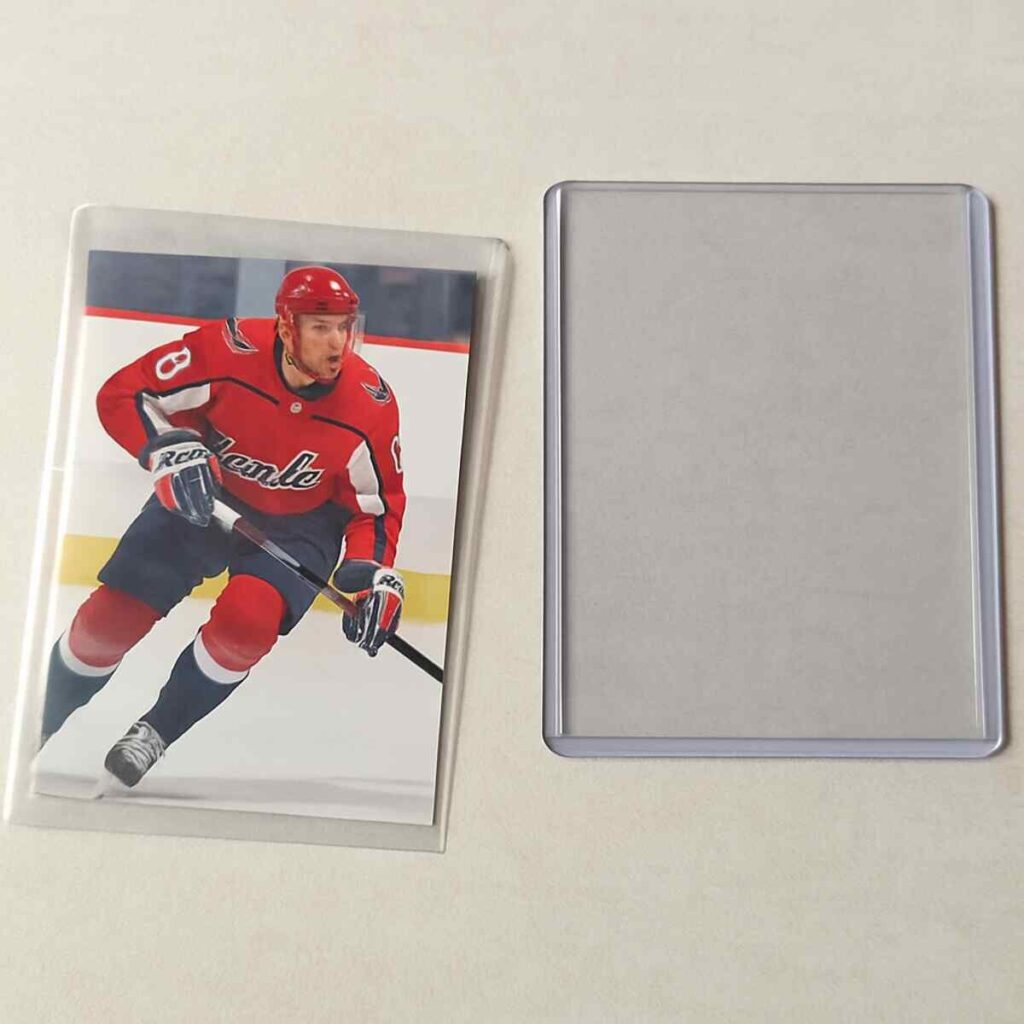
That instinct to protect a great find is spot-on. Bending a corner or scratching the surface can dramatically lower a card’s value, turning a treasure into a piece of damaged cardboard. Fortunately, hockey card collectors have a simple, inexpensive two-step method to prevent this. All you need are two items found at any hobby shop: a soft plastic “penny sleeve” and a rigid plastic “toploader.”
Think of it like protecting a smartphone. The penny sleeve is the screen protector; it’s a thin, clear sheath that guards the card’s delicate surface from dust and fingerprints. The toploader is the hard case; its rigid frame prevents your card from bending or getting dinged. Using both together gives you complete peace of mind for any card you care about, from a rookie you believe in to one of those special Upper Deck hockey cards with an autograph.
The process is simple: first, gently slide your card into the soft penny sleeve. Then, place the sleeved card into the opening of the rigid toploader, as shown in the photo. That’s it! This is the standard for how to store hockey cards that matter. But what about the dozens of common cards you’ll accumulate? You don’t need to put every single one in a case, and they can be used for something just as fun.
What About the Other 99%? How to Turn Common Cards Into a Fun Game
After carefully protecting your star players, you’ll quickly find yourself with a growing stack of common cards. What do you do with the dozens of players who aren’t superstars? Tossing them aside feels wrong, but they can quickly create clutter. This is where the real fun can begin. Instead of just being static collectibles, these cards hold the key to creating your own tabletop hockey game, turning a simple stack of cardboard into hours of entertainment.
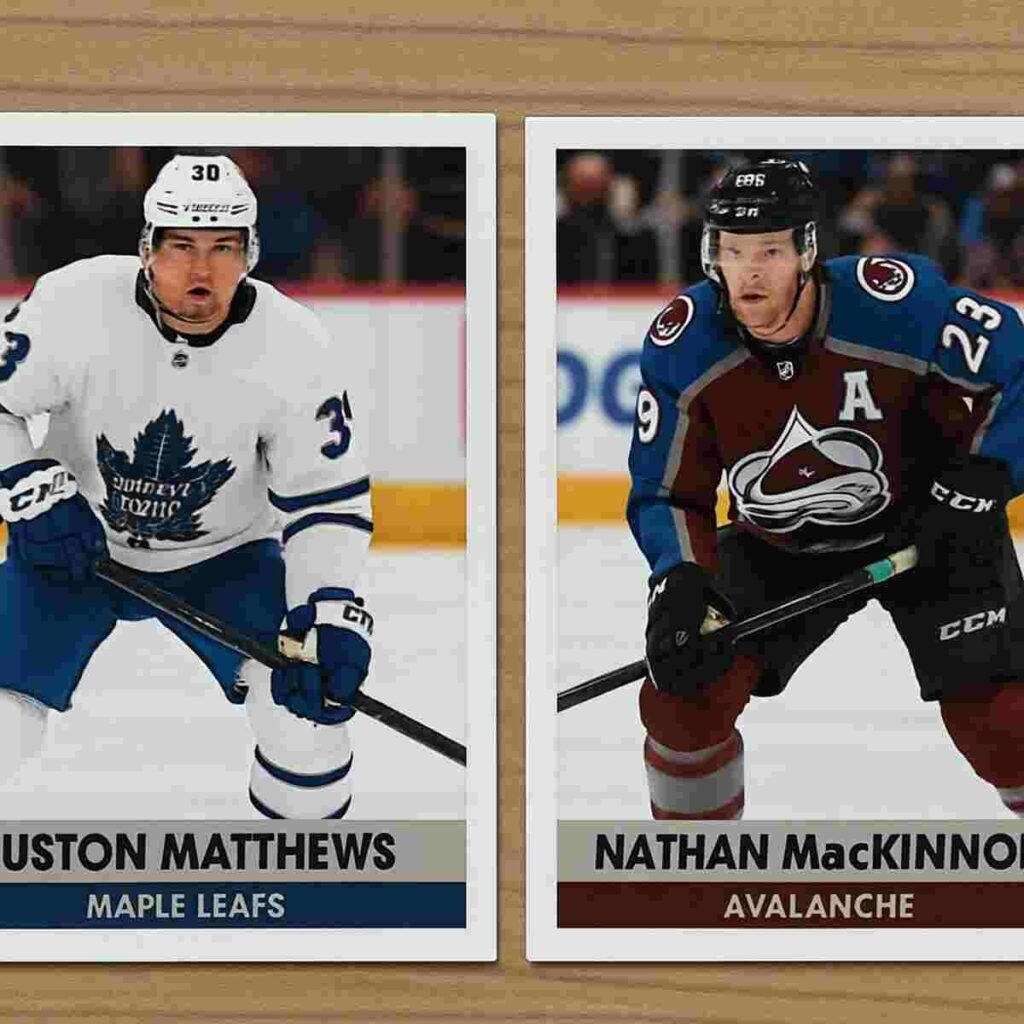
The secret is on the back of the card. Flip over any of these commons, and you’ll see a grid of statistics from the player’s career: Goals, Assists, Points, and more. Think of these numbers as a player’s power level, just like in a video game. A player with 40 goals is your heavy hitter, while one with 60 assists is your master playmaker. This data isn’t just trivia; it’s the engine that powers a simple competition right on your kitchen table.
Suddenly, that pile of cardboard transforms from a storage problem into your personal roster. You’re no longer just a collector; you’re the general manager building a team to compete. This is the ultimate answer for what to do with common hockey cards—you give them new life by playing a game. All you need is an opponent and a few simple rules to see whose lineup comes out on top in a quick round of “Top Line Tussle.”
‘Top Line Tussle’: The Simple 5-Minute Rules for a Hockey Card Battle
Ready to turn that stack of commons into a head-to-head competition? “Top Line Tussle” is a simple game for two players that brings player stats to life. The entire game is a strategic showdown where you try to use your players’ best attributes to win face-offs and capture your opponent’s cards. It’s the perfect way to learn the rules for a hockey trading card battle.
Getting started is easy. First, combine you and your opponent’s common cards into one shared deck and shuffle it. Place this deck face down between both players. To begin, each player draws five cards to create their starting hand. You can look at your cards, but keep them hidden from your opponent!
The game is played in rounds, with one player starting the first “face-off.” Here’s how this simple, two-player game with trading cards works:
- Choose Your Attacker: Player 1 selects a card from their hand, places it face-up on the table, and calls out a single stat category from that card—for example, “Goals!” or “Points!”
- Choose Your Defender: Player 2 then looks at their own hand and chooses a card they think can win that specific statistical battle.
- Declare the Winner: Compare the numbers in the chosen category. The player whose card has the higher stat wins the round.
- Take the Cards: The winner collects both cards and sets them aside in their own personal “won” pile.
- Draw Again: Both players draw a new card from the main deck to bring their hands back up to five cards. The winner of the last round starts the next one.
Play continues this way until the main deck runs out and you’ve played all the cards in your hands. To determine the ultimate winner, each player simply counts the cards in their “won” pile. The player who collected the most cards wins the game! This simple game based on hockey player stats can even be changed up by using unusual categories like “Penalty Minutes” to see whose enforcer comes out on top.
Once you’ve mastered the basics, you’re ready to take it to the next level. What if a special card could double your points, or a goalie could block any attack? Getting creative and inventing your own custom rules is where the real magic begins.
Creating ‘Power Plays’: 3 Ways to Invent Your Own Custom Rules
While the basic game is a fantastic starting point, the real magic begins when you start inventing your own rules. Just like a real hockey game has unpredictable bounces and momentum shifts, adding a few custom rules can make your card battles more exciting and replayable. Moving from simply following rules to creating them is what turns a simple pastime into your game. It’s a fun, creative way to bring your collection to life that’s very different from passive, numbers-driven fantasy hockey.
Ready to get creative? The best homemade rules for trading cards often blend a player’s real-life stats with a little bit of luck. This ensures that even a player with lower stats has a fighting chance to win a round, keeping both players on their toes until the very end. This blend of strategy and chance makes every single matchup a dramatic event.
Here are three simple ideas you can use to create your own “power plays” and build a unique dice game using your sports trading cards:
- Add a Luck Factor with Dice: When a player lays down their card, have them roll a single six-sided die. Add the number rolled to the stat they called out. Suddenly, a 40-goal scorer could get a lucky bounce and beat a 50-goal scorer!
- Give Goalies a ‘Save’ Ability: Let a goalie card be a game-changer. For example, a player could discard a goalie from their hand once per game to block an opponent’s attack, forcing both players to redraw.
- Make Rookie Cards Special: Designate a player’s “Rookie Card” (their first-ever card) as a trump card. It could automatically win any non-rookie matchup or allow you to steal a random card from your opponent’s won pile.
These ideas are just the beginning. Feel free to mix, match, and invent rules that sound fun to you—the goal is to create a game you and your friends love to play. Now that you see the strategic and creative potential locked inside each card, you might be wondering where to even begin building a collection.
Your First ‘Shift’: How to Start Your Hockey Card Journey Today
Before, a hockey card was just a picture on cardboard. Now, you see it for what it truly is: a ticket to two different games. One is the “game of collecting,” a thrilling treasure hunt where hockey card collectors search for rare rookies and special inserts. The other is the “game of playing,” where you become the coach and use your cards to battle for victory right on your kitchen table.
The best part? You don’t have to pick a side. You can jump into both worlds right now with a single pack of cards and a few simple steps. Get off the bench and onto the ice with this three-step game plan to begin your journey.
Your First Shift: A 3-Step Start
- Get Some Cards: Head to a local card shop or department store and buy one single pack of “Upper Deck Series 1.” It’s the perfect, most welcoming starting point for any new fan.
- Protect Your Hits: Did you pull a shiny card or one that says “Young Guns” on it? Slide it into a soft plastic “penny sleeve,” then into a hard plastic “toploader.” You just protected your first potential treasure.
- Play the Game: Now, what to do with common hockey cards? Grab that stack of base cards, a friend, and use the simple instructions for a card battle you learned to play a quick round of ‘Top Line Tussle.’
From now on, you’ll never look at a pack of cards the same way again. It’s no longer an intimidating mystery box, but a container of pure potential—for fun, for connection, and for the thrill of the hunt. Welcome to the hobby. You’re officially in the game.